
Your website has a job to do. For many service-based businesses, one of the most important goals is to get the right potential clients to your contact page.
Think about everything that happens before someone gets there. They might have found you through Google, clicked through from social media or been referred by someone they know. They’ve looked at your homepage, explored your services, read about your business and hopefully found enough information to feel confident that you’re someone they would like to work with.
Eventually, they arrive at your contact page.
The destination.
So when someone has made it all the way there, it makes sense to make contacting you as straightforward as possible.
This is where a simple contact form can be a smart strategy.
Getting to your contact page is the end goal
Your website should guide people towards taking action, and for many businesses that action is making an enquiry.
The pages leading up to your contact page all have a role to play. Your homepage needs to quickly explain what you do and who you help. Your service pages need to answer the questions a potential client is likely to have. Your About page can help build trust, while testimonials, case studies, pricing information and FAQs can help remove some of the uncertainty around getting in touch.
All of that information is helping someone decide whether they want to contact you.
When they click through to your contact page, they’ve made that decision.
They’ve gone from browsing to taking action, which is exactly what your website was designed to encourage.
So why make the final part of that process unnecessarily difficult?
A detailed form can look good in theory
There are some very good reasons for having a detailed enquiry form. It can help you understand a potential client’s needs before you speak to them, reduce back-and-forth emails and give you useful information for deciding whether an enquiry is a good fit for your business.
For some businesses, this approach makes perfect sense.
The problem is that every additional question adds a little more effort for the person filling out the form. If they don’t know the answer, don’t have the information to hand or simply aren’t ready to provide it, they may decide not to complete the form at all.
They’ve already decided they want to contact you, but the form has given them a reason to stop.
They might think they’ll come back to it later, but by the time later arrives, they’ve moved on with their day and that potential enquiry has disappeared with it.
Not everyone knows exactly what they need
This is particularly important for service-based businesses.
A potential client might know that they have a problem, but they may not know exactly which service will solve it. They might have an idea of what they’d like to achieve but haven’t worked out a budget or timeframe yet.
If your contact form requires them to make decisions they aren’t ready to make, you could unintentionally discourage someone who may have been a perfectly suitable client.
A simple form gives them somewhere to start the conversation instead. You can ask questions, explain your services and work out what they need once you’ve had that initial interaction.
But what if you want to weed out unsuitable enquiries?
Some businesses deliberately use a detailed contact form to filter out potential clients they don’t want to work with. They might ask about budget, project size, timeframe, location or other requirements so they can decide whether an enquiry is worth pursuing.
There is nothing wrong with qualifying potential clients. Your time is valuable, and not everyone who visits your website will be the right fit for your business.
The question I’d ask is whether your contact form is the best place to do all of that filtering.
Your website can do a lot of the qualifying before someone ever reaches your contact page. Your service pages can explain who your services are designed for, what you offer, where you work, what projects you take on and, where appropriate, your starting prices.
For example, if your website clearly states that a particular service starts from $3,000, someone looking for a $500 solution can make that decision for themselves before filling out your form. You’re not relying on a lengthy questionnaire to turn them away.
Let your website do some of the filtering
Think about the journey from the other direction.
You don’t necessarily need your contact form to decide whether someone should contact you. Your website content can help them make that decision for themselves.
Clear service descriptions, pricing or starting prices where appropriate, information about who you work with, your location and the types of projects you take on can all help potential clients decide whether you’re the right fit.
By the time someone reaches your contact page, they’ve had the opportunity to decide whether your business is suitable for them.
That means the contact form can have a much simpler job: give them an easy way to start the conversation.
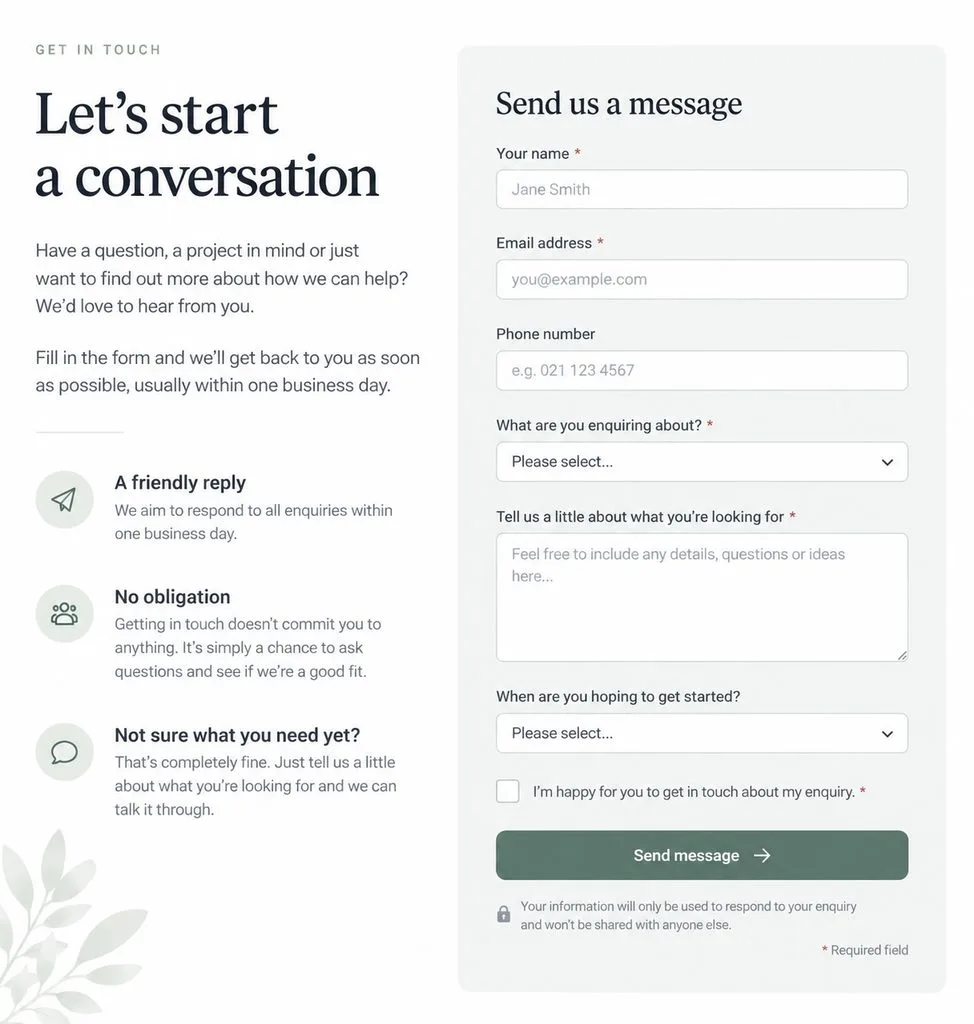
There is a difference between qualifying and creating friction
This doesn’t mean every contact form needs to contain nothing more than a name and email address.
A few carefully chosen questions can be genuinely useful. You might want to know which service they’re interested in, where they’re located or roughly when they’re hoping to get started.
The important thing is to consider what each question is actually doing.
Is it giving you information you need in order to respond, or is it there because you’d simply like to know the answer?
There’s a difference.
If someone has made it to your contact page and is ready to enquire, asking them to complete twenty fields can create unnecessary friction at exactly the point where you want the process to feel easy.
You can qualify clients after they’ve made contact
If you need detailed information before deciding whether to take on a project, there are other places to gather it.
You could ask additional questions when you reply to their enquiry, discuss their needs during an initial consultation or send them a more detailed questionnaire once they’ve expressed genuine interest.
This can also create a better experience for the potential client because you’re asking for information when it is relevant, rather than asking them to complete a lengthy form simply to make first contact.
Your contact form doesn’t need to be your entire client onboarding process.
Make the destination easy to reach
Your website has spent all that time helping someone decide that they want to contact you. Once they’ve arrived at the destination, don’t put a locked gate across the path.
A simple contact form isn’t about accepting every enquiry or removing all qualification from your sales process. It’s about being intentional about where that qualification happens.
Use your website to communicate who you work with and what you offer. Use your service pages to set expectations. Provide pricing or minimum project information where it makes sense for your business.
Then, when the right person reaches your contact page, make it easy for them to say hello.
For many businesses, a name, contact details, an indication of what they’re enquiring about and a short message will be enough to get the conversation started.
You can always ask more questions once the conversation begins.
Frequently Asked Questions:
How many fields should a contact form have?
There isn’t a set number of fields that works for every business, but a contact form should generally ask for the information you actually need to respond to an enquiry. For many service-based businesses, this might include a name, email address, phone number, service they’re interested in and a short message.
Should a business contact form be short or detailed?
A short contact form can make it easier for potential clients to get in touch, particularly when the purpose of the form is to start a conversation. A more detailed form can be appropriate when a business needs specific information to qualify enquiries before responding.
Should I ask for a client’s budget on my contact form?
A budget question can be useful for some businesses, particularly where projects have a wide range of prices or minimum project costs. However, it isn’t always necessary for a first enquiry. Consider whether you need to know someone’s budget before you can respond, or whether pricing information on your website could help qualify potential clients instead.
How can I stop unsuitable clients from contacting me?
Your website can help qualify potential clients before they reach your contact form. Clear service descriptions, pricing or starting prices, project requirements, locations and information about who you work with can help people decide whether your business is right for them. Additional qualification can then happen after the initial enquiry.
Why is a simple contact form important?
A simple contact form reduces the amount of effort required for someone who has already decided to get in touch. If a potential client reaches your contact page but is faced with a long or complicated form, they may abandon the enquiry before submitting it.